
Among all authors of feminist science fiction, Margaret Atwood's 'The Handmaid's tale' is considered to be a classic feminist icon, a revolutionary and thought-provoking book, the likes of which had never been seen before in the Post-modern Era. It explores the ever-prevalent topic of reproductive rights and women's power through a stunningly daring dystopian novel.
The book 'The Handmaid's Tale' by Margaret Atwood delves into the horrors of a totalitarian, theocratic society in a time of plummeting birth rates and radioactive waste. The story is set in a futuristic America called the 'Republic of Gilead', where women are property of the state and are placed into a class system starting from the lowest, 'Econowives' to 'Marthas', 'Handmaids' and 'Wives'. Women in this society thus lose their original name and are given replacement names that correlate with their 'Commander'-i.e. the man of the household. Handmaids are women who are fertile- something that is rare in Gilead and are thus considered a 'national resource'.
 |
| Handmaids in Gilead are depicted with bright red clothing signifying their fertility |
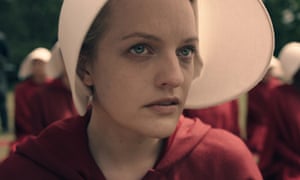 |
| Offred from the T.V series adaptation by Hulu |
Truth be told, when I began reading this novel, I found Offred's submissiveness and complacency irritating and often found myself frustrated at her lack of drive to stand up against the oppressive regime. As a proud, 21st Century female, I could not for the life of me, conceive the notion of not fighting back against such blatant mistreatment of women. It felt absurd to me-how could she not want to fight back? Yet, as I continued discovering more about her past and the brutality of the regime, I began to feel sympathetic towards Offred's lack of control over her life, and gained respect for her subtle, fruitless, displays of rebellion. My initial distaste for Offred’s silent rebellion made me realise the constant pressure Western society puts upon women all over the globe to fight back regardless of the direness of the situation. We tend to scrutinise 3rd world countries’ women for not standing up for themselves in grand gestures of rebellion, often disregarding upbringings and life situations. What struck me as silent, futile resistance was a cry of revolt amidst the heartless regime of Gilead.
One quote that struck me the most whilst reading the novel was:
"I used to think of my body as an instrument, of pleasure, or a means of transportation, or an implement for the accomplishment of my will . . . Now the flesh arranges itself differently. I’m a cloud, congealed around a central object, the shape of a pear, which is hard and more real than I am and glows red within its translucent wrapping."
The quote is taken from a pivotal scene in the story where Offred muses about the change in her perception of herself as she sits naked in the bath. This scene struck me the most as it shows the detrimental impact that Gilead's reproduction-focused regime has on women's self perception. Before Gilead, Offred considered her body as an extension of herself and part of her identity, whereas now she sees herself solely by her uterus -her ability to conceive. This shows how Gilead dehumanises women by reducing them to their fertility and an referring to them as a 'resource'. By classifying women by their ability to give birth to children and using terms such as 'unwoman' to describe an infertile woman, Gilead compromises women's identity in order to perpetuate childbearing as the only purpose of a woman. This can be seen in Offred's comments of herself as a 'cloud congealed around a central object'. The use of 'cloud' to describe the rest of herself shows that she doesn't consider anything else other than her womb as part of her identity, stating that it is 'more real than I am'.
 Though Gilead suggests a 'could be' rather than a prophecy, the topics explored throughout the novel remain startlingly relevant to today's society. With the debate on abortion clinics and women's reproductive rights re-surging under the light of Donald Trump's presidency, questions continue to be raised about the paths currently being taken, and what it means for our future.
Though Gilead suggests a 'could be' rather than a prophecy, the topics explored throughout the novel remain startlingly relevant to today's society. With the debate on abortion clinics and women's reproductive rights re-surging under the light of Donald Trump's presidency, questions continue to be raised about the paths currently being taken, and what it means for our future.


I'm really impressed by the time and effort you put into analysing the book and putting this blog together!
ReplyDelete